
What Everyone should know about Violence Against Women and Children
Violence comes in many forms. It is not just physical, like a black eye or a swollen face. Other forms of violence are less visible but equally painful and damaging.
Incidents involving video-taping and the posting/circulating of such material has brought about many questions as to what kind of abuse or violence is punishable.
There is currently no law that specifically punishes the acts of video-taping a sexual or other private act and circulating this content without the consent of the persons involved. I filed a bill in the senate known as The Anti-Video Voyeurism Act of 2009 that seeks to punish these acts. I hope this will be heard and passed into law soon.
At present though, victims can take refuge in Republic Act 9262 otherwise known as the Anti-violence against Women and Children Act of 2004 which penalizes various forms of violence. A victim can also claim for damages.
Sometime ago I wrote about my campaign along with women parliamentarians all over the world to end violence, “Say No to Violence Against Women“.
Women Parliamentarians join the campaign to end violence
Many of my colleagues joined this signature campaign to end violence.
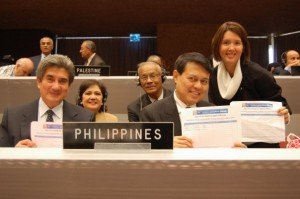
Senators Villar, Honasan and Biazon and I at the IPU Conference in Geneva. They joined the signature campaign

Minority Floor Leader and I at the IPU conference in Geneva. He also joined the signature campaign to end violence
My office and some local groups we work with conduct seminars to increase awareness on this issue.
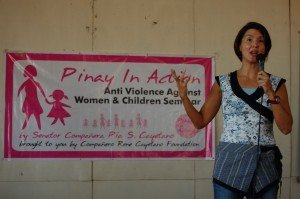
Talk on violence in Davao City
Below is a partial replication of the Primer on Violence against Women and Children that my office distributes. It includes contact information on where to go for help.
What are the different acts of violence.
1. Physical violence – acts that include bodily or physical harm;
2.Sexual violence – acts which are sexual in nature;
3.Psychological violence – commission or omission of acts which cause mental or emotional suffering of the victim;
4. Economic abuse – acts that make a woman financially dependent on the offender.
Who are protected under the law?
The Anti-VAWC Act protects women and their children, specifically:
1.Wife or former wife of the offender;
2.Woman with whom the offender has or had a dating or sexual relationship;
3.The mother of the child of the offender;
4.The child, whether legitimate or illegitimate of the woman.
Who are punished by the law?
The following are liable:
1.Husbands or former husbands;
2.Any person with whom the victim has or had a sexual or dating relationship (e.g. boyfriends, live-in partners, or lesbian partners);
3.Any person with whom the victim has a common child;
4.Father of the child-victim
What can I victim of violence, do?
The victim can file any or all of the following:
1.Protection Orders
a. Barangay Protection Order
b. Temporary and Permanent Protection Orders
2.Independent Civil Action for Damages
3.Criminal Action for Violation of the Anti-VAWC Act
What is a Barangay Protection Order (BPO)?
A BPO is the protection order issued by the Punong Barangay, or by any kagawad, if the Punong Barangay is unavailable. It commands the offender to refrain or stop from committing or threatening to commit harm to the victim. The Order is valid for only 15 days.
What is a Permanent Protection Order (PPO)?
A PPO is the Order issued by the court commanding the offender from further committing or threatening to commit harm to the victim. It is issued after notice and hearing wherein the offender is given the opportunity to present his evidence. A PPO is effective until revoked by a court upon application of the victim or by an authorized applicant, if the application was not filed by the victim.
What are the penalties for committing VAWC?
If the courts have proven that the offender is guilty of the crime, he may be imprisoned and will be obliged to pay P100,000 to P300,000 in damages. The length of imprisonment depends on the gravity of the crime.
WHO TO GO TO FOR HELP:
LAW ENFORCEMENT AGENCIES
1. Philippine National Police Women and Children Concerns Division (PNP-WCCD)
PNP-WCCD was established to administer and handle cases involving women and children victims of gender-based crimes. It also serves as a central venue for the reporting of all cases involving women and children. This unit, managed mostly by policewomen, has become an instrument in police-community relations that is dedicated to providing services and protection to the victims of abuse and violence.
Tel. Nos. 7230401 loc 3480, 3691, 3651
Call or text 117
Itext mo kay Aleng Pulis – 09197777377
2. National Bureau of Investigation Violence Against Women and Children’s Desk (NBI-VAWCD)
The Violence Against Women and Children Division (VAWCD) of the NBI VAWCD investigates cases involving abuse against women and children including violations of the Anti-Sexual Harassment Law, the Anti-Rape Law and the Law Prohibiting Mail Order Bride and other related crimes defined in the Revised Penal Code.
CRISIS CENTERS
1. Department of Social Welfare and Development (DSWD)
Crisis Intervention Unit (CIU)
Tel. Nos. 734-8617 to 18
The DSWD-Crisis Intervention Unit (CIU) is a special unit operating on a 24-hour basis, which serves as a receiving and action center for walk-in referred, and rescued individuals and families in crisis situation. It provides integrated services that include protection and provision of immediate medical, legal and psychosocial services to individuals and families in crisis situation. It will also provide accommodation or temporary shelter, food, and transportation assistance for a limited period.
2. Women’s Crisis Center Care and Protection Unit of East Avenue Medical Center
This is a non-profit private institution with a firm commitment to end violence against women.It offers a comprehensive range of crisis intervention services for survivors of gender-based violence.
They offer physical facilities like research center/library, temporary shelter for VAW victims, and training centers/ camp facilities. They conduct information campaigns and give trainings and seminars.
Tel. Nos. 9267744, 9225235
3. Women’s Desk of Philippine General Hospital
The UP-PGH Women’s Desk is a crisis center for women survivors of violence located at PGH’s emergency room complex, beside the Child Protection Unit. They offer support services such as counseling and referrals to other departments and agencies. They give paralegal counseling for the survivors as well as for the doctors who will serve as expert witnesses. They also provide medical and psychosocial intervention.
Tel. No. 5242990
LEGAL
1. Department of Justice Public Attorney’s Office (DOJ PAO)
Women’s Desk
The DOJ provides free legal assistance/representation to indigents and poor litigants in criminal, civil, and labor cases, administrative and other quasi-judicial proceedings and non-commercial disputes through the Public Attorney’s Office (PAO).
Tel. Nos. 929-9010, 929-9436 to 37
2. Sentro ng Alternatibong Lingap Panlegal or SALIGAN
Saligan handles cases of women victims of gender-based violence. They advocate for the enactment of laws addressing women’s issues. They also hold information campaigns on relevant laws and bills on women.
Tel. No. 4266001 loc 4858 to 60
3. GABRIELA
Gabriela Women’s Party is a sectoral party dedicated to promoting the rights and welfare of marginalized and under-represented Filipino women . They fight for legislative measures that would strengthen actions with respect to sexual violence. They fight human rights violations against women in all its forms and conducting information and education campaigns to protect women. They also facilitate legal assistance, crisis intervention and just compensation to women who are victims of violence, etc.
Tel. No. 3743451, 3712302
COUNSELING
1. World Vision Development Foundation, Inc. [WVDF, Inc.]
World Vision is a Christian relief, development and advocacy organization that offers counseling for abused women and children.
Tel. Nos. 374-7618 to 28
2. Catholic Women’s League Philippines, Inc. [CWL]
It is a charitable, religious, socio-economic, civic, non-partisan, non-profit organization that offers counseling for abused women and children.
Tel. Nos. 523-2956, 523-3144
ADVOCACY/INFORMATION CAMPAIGN
1. Kababaihan Laban sa Karahasan or KALAKASAN Foundation
Kalakasan is a women’s rights organization committed to the protection and safety of women and girls through the elimination of violence and abuse. Kalakasan focuses on the empowerment of victims and survivors of violence and abuse with support services, education and information and advocacy.
Tel. No. 7355555
2. Sentro ng Alternatibong Lingap Panlegal or SALIGAN
Tel. No. 4266001 loc 4858 to 60
3. GABRIELA
Tel. No. 3743451, 3712302

a very nice organization for women who doesn’t know how to end up violence against them.
Hello senator Pia,
More power to you and to all women who stands up against violence and abuse, in all forms! I admire and have high respect for women like you. God bless you and be with you and your family always.
Noemi
Men opposed to violence against women everywhere-MOVE . i believe shld support this advocacy
Yes, MOVE is a vital partner in the fight to end violence.